

Hotel Fanny: A Brothel in the barrio Cabañas, San Pedro Sula, Honduras. February 1993
This one of a series of photographic essays which document the principle transmission route of the HIV/AIDS epidemic from the city’s brothels and street sex workers into the wider population of San Pedro Sula.
My purpose in photographing sex workers at the Hotel Fanny brothel was to document the connection between HIV/AIDS infections and the role sex workers were playing in the transmission of the HIV virus into the wider population of San Pedro Sula.
Community health workers had informed me that the principle route of the HIV/AIDS virus transmission in San Pedro Sula was predominately heterosexual. The accepted culture of men and boys using the services of sex workers at the cities brothels was common place, also in a country with high levels of poverty, unemployment and poor education, sex work for women working at a brothel was often a better alternative than destitution.
Sex workers at a brothel are the most vulnerable group likely to carry the HIV virus. Typically the HIV virus was being transmitted into the general populace from female sex workers to male clients, then onto their wives and partners. HIV positive pregnant mothers were also transmitting the HIV virus onto their unborn children.
Health workers had suggested I could try and visit Hotel Fanny a brothel in the barrio (district) Cabañas, a marginal community in San Pedro Sula. They believed the women working there were most likely HIV positive, although none had been tested at that time.
Gaining access and cooperation to photograph at Hotel Fanny was problematic, so I requested a meeting with Jaime Brufau Maciá, the Bishop of San Pedro Sula, after explaining my purpose, which he fully supported, he provided me with a letter of introduction that requested the reader assist me with my project. This letter enabled me to make several visits to photograph at Hotel Fanny.
For the women at Hotel Fanny their future is bleak, with no antiretroviral medications available at this time they will continue at the brothel until they are too ill to work. As their health deteriorates they will most likely be admitted to the San José Hospice, possibly together with their clients.
I returned the following year (1994) and found that Hotel Fanny had been burnt to the ground by a rival brothel owner.
In 1995 I visited Chicas Bar a brothel also in the barrio Cabañas and did further research into understanding how the brothel debt system or debt bondage, a financial system which controls and entraps women into an inescapable debt. Today these methods of control and exploitation of sex workers are known as modern slavery.
These photographs/text have been used worldwide by agencies, charities, university libraries and archives to record, illustrate and publicise the HIV/AIDS epidemic in San Pedro Sula, Honduras. 1993-95.
An exhibition featuring photographs from the San José Hospice and Hotel Fanny from 1993 was purchased by the Untied Nations Population Fund (UNFPS) and exhibited at the International Conference on Population and Development in Cairo in 1994.
Panos Pictures and the World Health Organisation.
A selection of photographs were used in the C4 documentary film, the Bar Girl, the Catholic the Pimp and the Priest (1994) which documented the debt system which entraps girls into sex work.
In 2007 photographs were used The American Foundation for Aids Research (amfAR) in New York to help fund and promote their work. The resulting DVD was narrated by Elizabeth Taylor and Edward Kennedy.
During July 2026, 100 digital captioned photographs, diary excerpts and texts from all the projects listed below were acquired by the University of California San Fransisco digital Calisphere library for long term preservation, academic study and public accessibility.
Links to other associated web pages:
- HIV/AIDS patients at the San José Hospice 1993
- HIV/AIDS patients at the San José Hospice 1995
- The Last Days, Death and Funeral of José Martinez 1993
- Chicas Bar brothel and Street Sex Workers 1994/5
All images are Strictly Copyright © Bill Stephenson All Rights Reserved

[HON 27] A sex worker outside her room at the rear of Hotel Fanny.

[HON 28] The interior of her room where she brings her clients. She sleeps and lives in this small room which contains all her possessions.

[HON 29] Three sex workers in the largest room at Hotel Fanny.

[HON 30] The women have fun pretending to present themselves to clients.

[HON 31] This woman is known at Hotel Fanny as ‘the crazy one’.

[HON 32] The women prepare to meet the evening’s clients.

[HON 33] It’s 10am and some of the women have just returned from working all night at a cattle ranch on the outskirts of San Pedro Sula. They wash their clothes, themselves, and then sleep until the evening and start work again. One has a cigar given to her by a client.
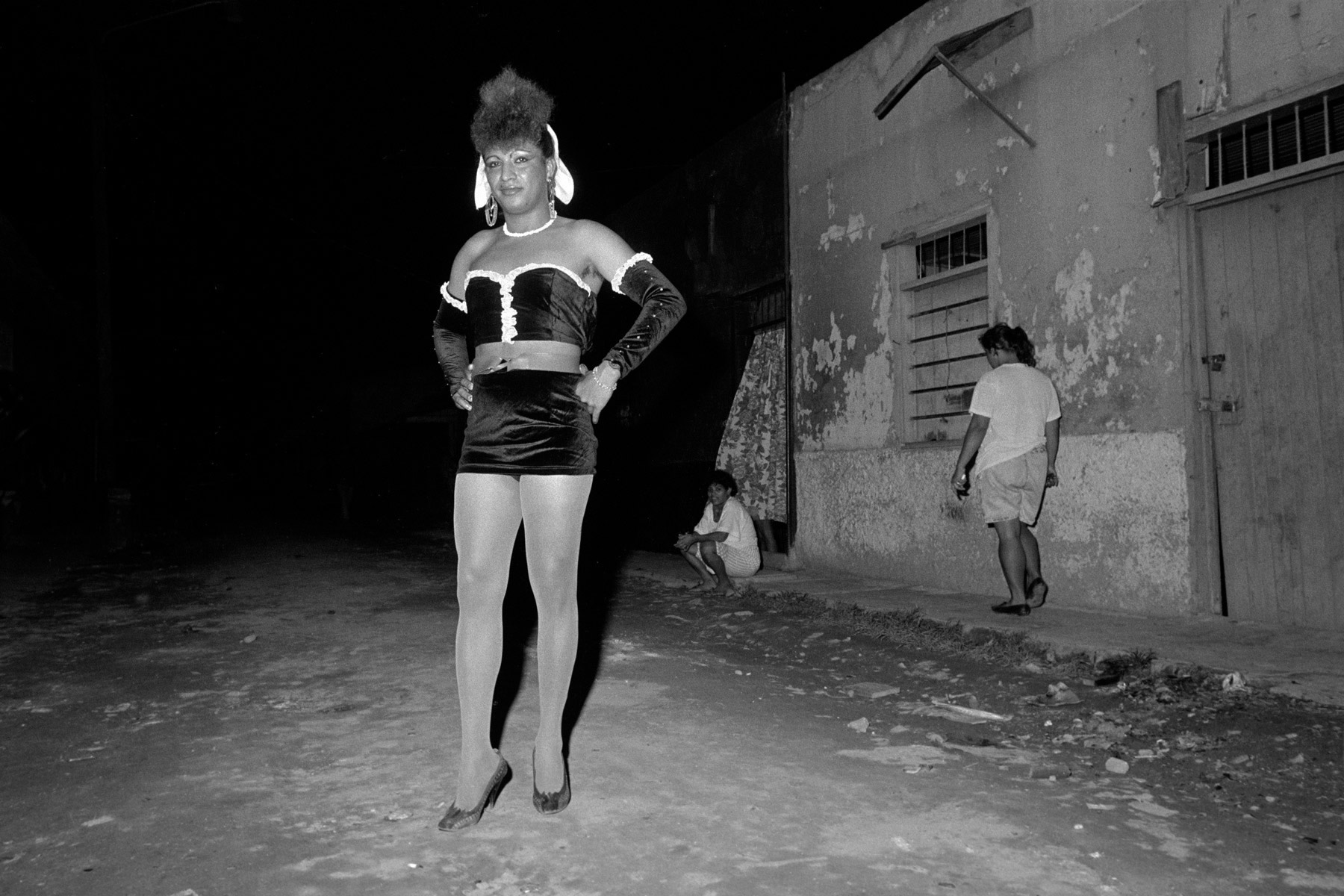
[HON 34] Renée is a transgender sex worker. He was born male but identifies himself as female. His partner had recently died from an AIDS related illness. Renée is justifiably concerned about his own health and has not been tested for HIV. Renée’s clients are gay men.

[HON 35] The room where Renée lives and brings his clients.
[HON 27] A sex worker outside her room at the rear of Hotel Fanny.
[HON 28] The interior of her room where she brings her clients. She sleeps and lives in this small room which contains all her possessions.
[HON 29] Three sex workers in the largest room at Hotel Fanny.
[HON 30] The women have fun pretending to present themselves to clients.
[HON 31] This woman is known at Hotel Fanny as ‘the crazy one’.
[HON 32] The women prepare to meet the evening’s clients.
[HON 33] It’s 10am and some of the women have just returned from working all night at a cattle ranch on the outskirts of San Pedro Sula. They wash their clothes, themselves, and then sleep until the evening and start work again. One has a cigar given to her by a client.
[HON 34] Renée is a transgender sex worker. He was born male but identifies himself as female. His partner had recently died from an AIDS related illness. Renée is justifiably concerned about his own health and has not been tested for HIV. Renée’s clients are gay men.
[HON 35] The room where Renée lives and brings his clients.
All images are Strictly Copyright © Bill Stephenson. All Rights Reserved.